Preprocessing Equipment for Fibrous Substrates: Size Reduction, Mixing, and Pretreatment Fit
Fibrous substrates can look attractive on a gate-fee or availability basis, but they rarely behave like pumpable, uniform feedstock. Straw, grass silage, crop residues, press fibers, manure bedding, and food-processing fibers can bring high structural carbohydrate value into a digester while also increasing floating layers, mixing load, viscosity, foaming tendency, and hydrolysis lag.
For operations managers, the question is not whether preprocessing is useful. The question is which equipment step removes the real bottleneck without creating new maintenance cost, power draw, or process stress.
AneroShift works with plants as an enzyme supplier for biogas production where fibrous feedstocks need faster hydrolysis, more stable conversion, and clearer trial data. Enzymes do not replace good mechanical preparation. They perform best when the substrate has been made accessible, distributed, and dosed into the biology with control.
What preprocessing must solve in a fibrous feedstock line
Before specifying equipment, define the operational problem. Fibrous material can limit plant performance in several ways:
- Slow hydrolysis: intact plant structure delays conversion and can push gas production later than the retention-time target.
- Poor wettability: dry, buoyant fibers resist slurry contact and can float into crusts.
- High viscosity: long fibers and swollen solids increase mixing energy and reduce mass transfer.
- Inconsistent dosing: bales, clumps, and stringy material create peaks in organic loading.
- Foam and scum risk: entrained air, surface-active compounds, and incomplete wetting can destabilize the digester surface.
- Maintenance exposure: stones, twine, sand, and metal fragments can turn a feedstock win into a pump and auger problem.
The right preprocessing train usually combines contaminant control, particle-size reduction, wetting and mixing, and, where justified, mechanical, thermal, chemical, or biological pretreatment.
Equipment map: from reception to digester feed
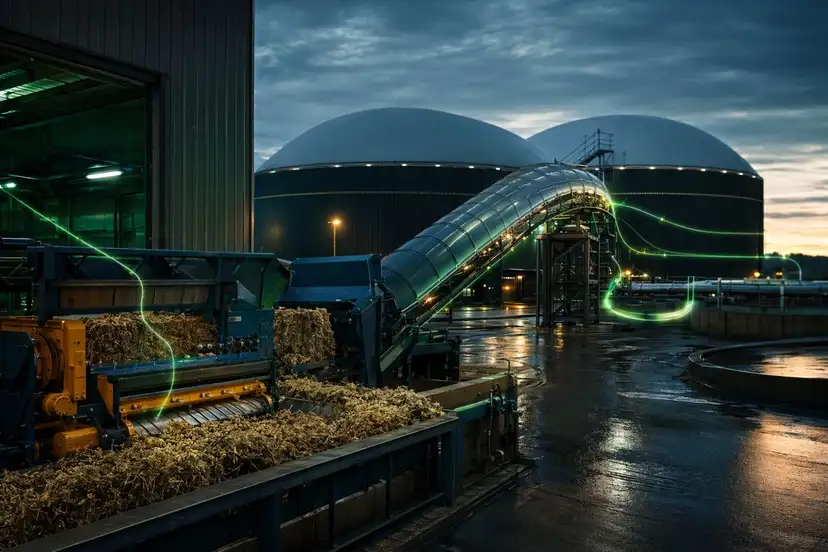
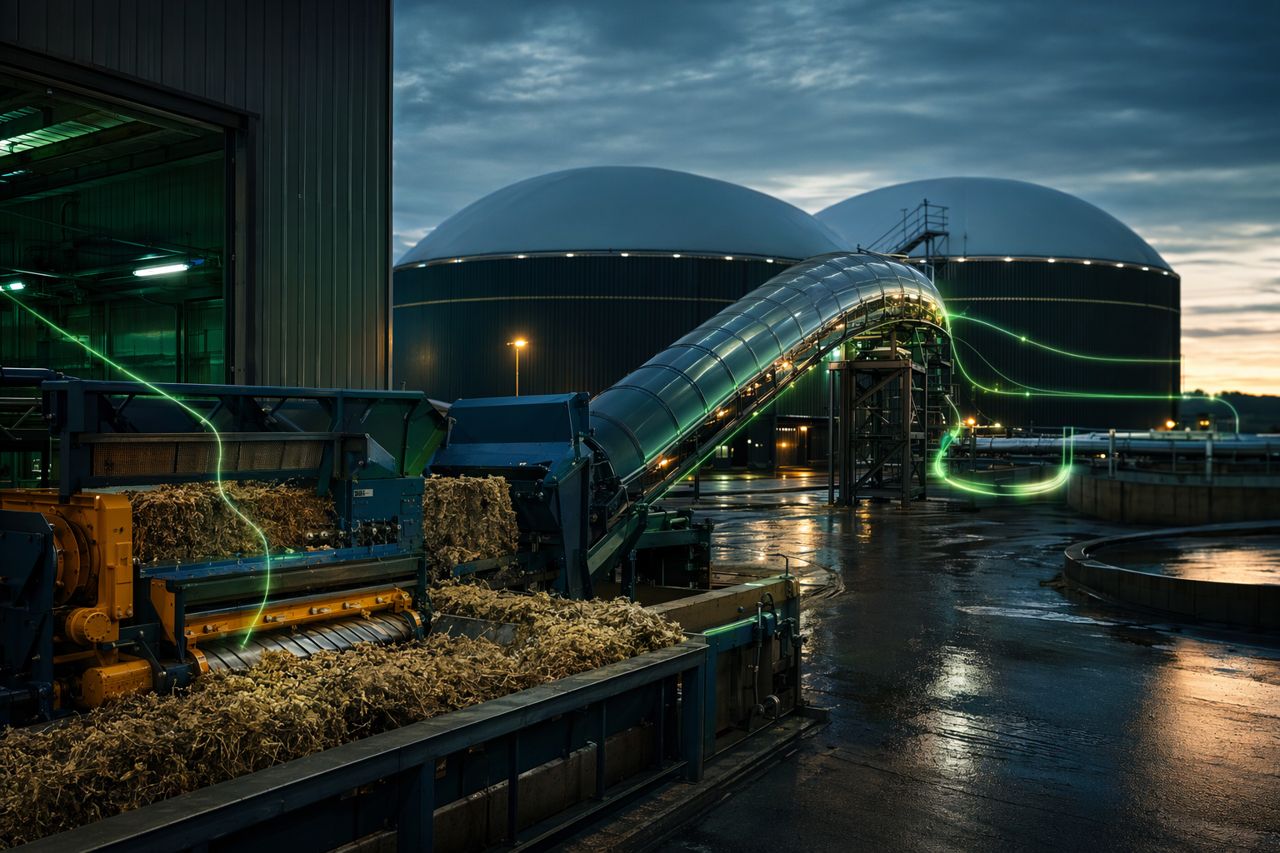
A practical fibrous-substrate line often includes these stages.
1. Reception and metering
Walking floors, push floors, bale breakers, hoppers, and dosing screws turn variable deliveries into a controlled feed rate. This stage sets the tone for the whole process. If the reception system surges or bridges, the digester sees uneven loading, and any downstream enzyme or pretreatment program becomes harder to evaluate.
Buyer focus:
- Can the system handle the wettest and driest expected loads?
- Does it prevent bridging without excessive operator intervention?
- Is metering accurate enough to support a controlled trial?
- Are contaminants removed before they reach expensive equipment?
2. Size reduction
Shredders, hammer mills, choppers, macerators, and cutting mills expose fiber surface area and reduce long-strand behavior. More reduction is not always better. Very fine material may improve accessibility but can increase power demand, wear, and slurry thickening.
For most biogas plants, the goal is a particle profile that improves wetting and hydrolysis without over-processing.
Operational signs that size reduction is helping:
- fewer floating mats and rope-like accumulations;
- more uniform feed pump behavior;
- faster onset of gas production after feed changes;
- lower mixing strain at the same feedstock share;
- more predictable digestate texture.
Operational signs that size reduction is going too far:
- steep electricity increase without gas benefit;
- accelerated wear on blades, screens, and liners;
- higher slurry viscosity from excess fines;
- more maintenance stoppages at the front end.
3. Wet mixing and slurry conditioning
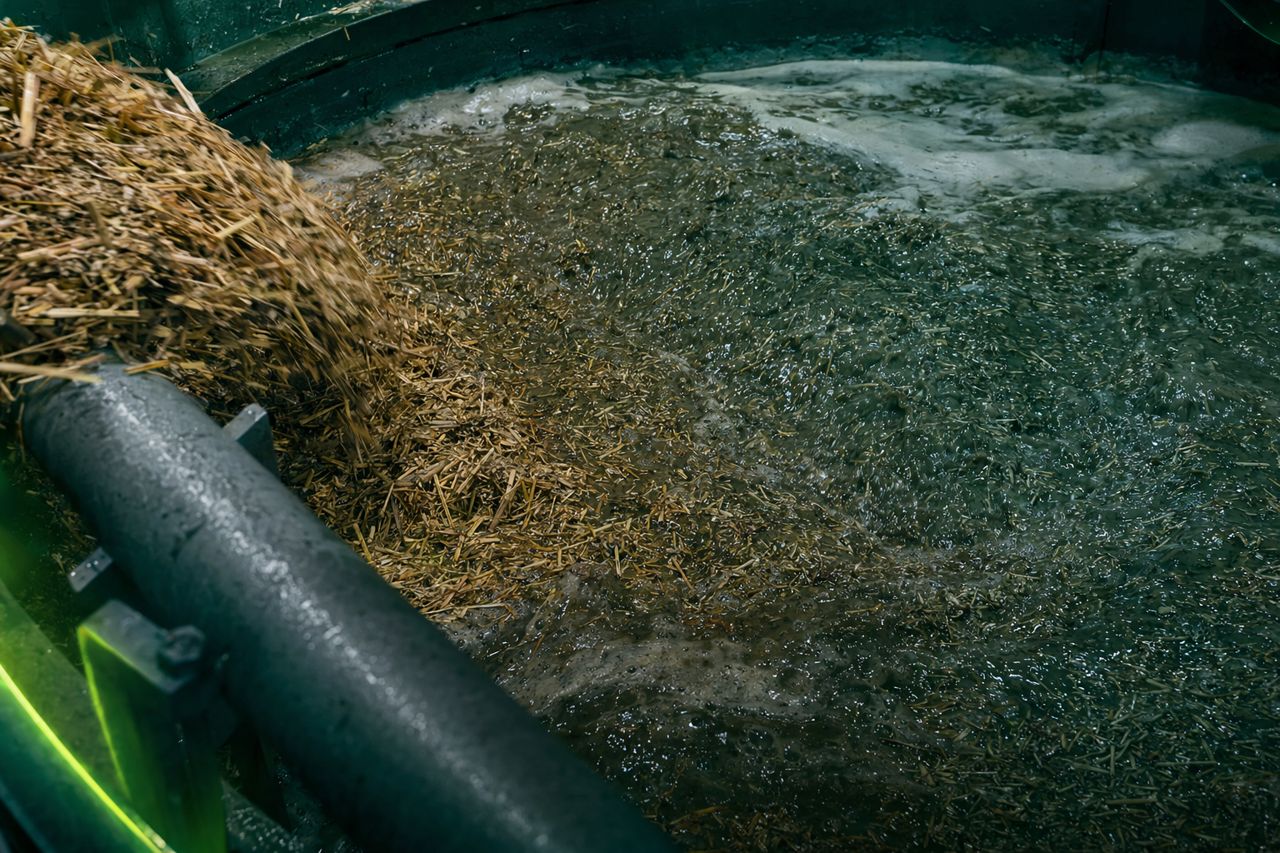
Once fibers are reduced, they need contact with liquid. Paddle mixers, slurry tanks, hydropulpers, recirculation loops, and high-shear inline systems can improve wetting and distribution before the digester.
This step is often where enzyme programs become more predictable. Enzymes need access to the substrate surface and a contact window before or during digestion. A well-mixed slurry helps avoid localized overdosing, dry pockets, and feed pulses that create VFA stress.
Practical design questions:
- Is there enough mixing intensity to wet fibers without entraining excessive air?
- Can recirculated digestate be used to condition dry material?
- Is the contact time consistent from day to day?
- Can the line dose enzyme into a stable flow rather than a lumpy batch?
4. Mechanical pretreatment
Mechanical pretreatment includes milling, extrusion, defibration, pressure-shear systems, and disintegration units. These technologies can open fiber structure and improve hydrolysis, especially for lignocellulosic material. They also add capital cost, wear parts, and energy demand.
A strong business case depends on feedstock volume, substrate value, current bottleneck, and retention-time pressure. If the plant already has mixing or heating constraints, aggressive mechanical pretreatment may shift the bottleneck rather than solve it.
Use mechanical pretreatment when:
- the plant has a stable supply of fibrous material;
- the current line cannot process enough substrate without scum or viscosity problems;
- the gas uplift can be measured against clear baseline periods;
- maintenance access and spare parts are acceptable for the operating team.
5. Thermal and thermo-mechanical pretreatment
Heating can improve substrate softening and may support hygienization requirements, depending on local rules and feedstock type. Combined thermal and mechanical systems can increase fiber accessibility, but they require careful energy balance.
For biogas operations, the key question is simple: does the additional gas, stability, or throughput justify the heat input and equipment complexity?
Thermal steps should be reviewed alongside:
- available waste heat;
- heat exchanger fouling risk;
- condensate and odor management;
- downstream viscosity change;
- impact on ammonia release or process inhibition risk.
6. Chemical or alkaline pretreatment
Alkaline or chemical pretreatment can open lignocellulosic structure, but it also changes process chemistry. Plants considering this route need strong control over dosing, safety, digestate requirements, and cost of reagents.
This is not a casual retrofit. It should be evaluated with laboratory and plant-side data, including alkalinity, sodium or potassium load, downstream biology, digestate use, and permitting considerations.
7. Biological and enzymatic pretreatment
Enzymatic support can help accelerate the breakdown of cellulose, hemicellulose, starch residues, proteins, fats, or mixed organics depending on substrate profile. For fibrous materials, the strongest fit is usually where mechanical preparation has created access but hydrolysis remains the rate-limiting step.
AneroShift enzyme programs are built for plant trials, not guesswork. We look at feedstock mix, retention time, digestate recirculation, viscosity behavior, gas profile, VFA trend, foam history, and operating constraints before recommending a dose strategy.
Where enzymes fit with preprocessing equipment
Think of equipment and enzymes as a sequence, not a substitute relationship.
- Shredding creates access. Enzymes act more consistently when fibers are cut, cracked, or defibrated.
- Mixing creates contact. Enzymes need distribution through the slurry rather than concentration in one hopper zone.
- Pretreatment reduces resistance. Heat, shear, or conditioning can make the feedstock more responsive.
- Digester control protects the gain. Gas uplift is only valuable if VFA, alkalinity, foam, and viscosity remain manageable.
When plants treat enzymes as a bolt-on after unstable feeding, results are harder to read. When enzyme dosing is aligned with reception, particle size, contact time, and feed schedule, the trial becomes much cleaner.
Building a measurable plant trial
AneroShift recommends a controlled field protocol before long-term supply decisions. The protocol should be simple enough for operators to run and strong enough for management to trust.
Baseline period
Document normal operation before changing the line. Capture:
- daily feedstock tonnage and mix;
- dry matter and volatile solids trends where available;
- gas volume and methane concentration;
- VFA and alkalinity trend;
- digester temperature;
- mixing load or observable viscosity indicators;
- foam, scum, and pumping notes;
- retention time and recirculation pattern.
Change one main variable at a time
If a plant installs a new shredder, changes mixing, and starts enzymes on the same day, the result may be positive but attribution becomes weak. In many cases, the better route is staged implementation:
- stabilize the mechanical line;
- confirm feed metering and particle consistency;
- introduce enzyme dosing into a defined contact point;
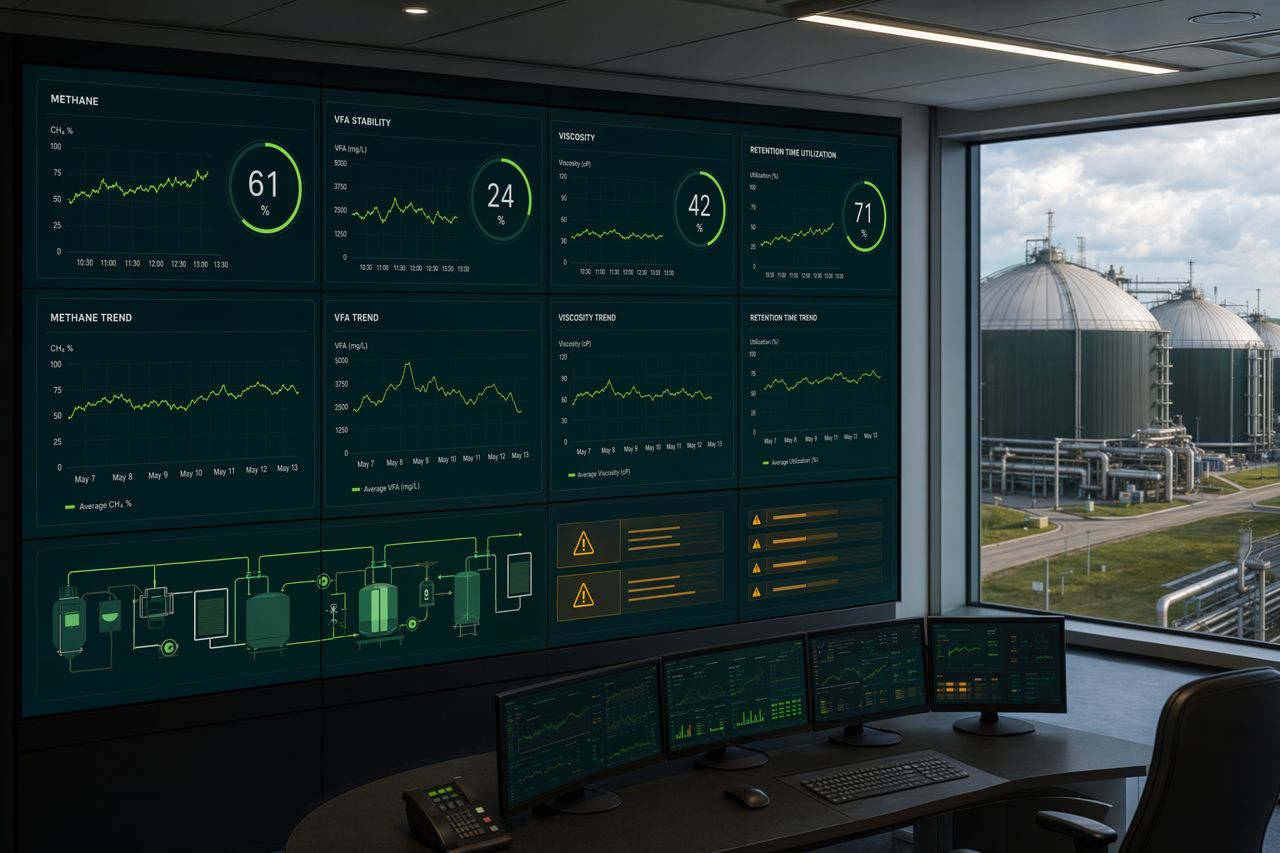
- monitor gas, methane, VFA stability, foam, and viscosity indicators;
- compare against the agreed baseline and feedstock-adjusted expectation.
Define success before the trial starts
A useful trial target is not just “more gas.” It may include:
- methane uplift at the same feed rate;
- ability to raise fibrous feedstock share without VFA stress;
- reduced foam events;
- lower mixing strain or improved pumpability;
- faster recovery after feedstock changes;
- improved retention-time utilization;
- reduced unconverted fiber in digestate observations.
Common specification mistakes
Buying the most aggressive shredder first
Aggressive size reduction can solve long-fiber problems but create wear, fines, viscosity, and energy issues. Match the machine to the substrate and the digester’s hydraulic reality.
Ignoring wetting behavior
A chopped fiber that still floats is not fully prepared. Wetting and slurry contact often determine whether the biology sees the substrate in time.
Treating all fibrous materials the same
Straw, grass, maize residues, manure bedding, and vegetable processing fibers behave differently. Lignin level, moisture, ash, waxy surfaces, and storage condition all affect equipment fit and enzyme response.
Measuring only total gas
Total gas can move for reasons unrelated to improved hydrolysis. Track methane concentration, loading, VFA stability, foam, and retention-time context.
Starting enzymes without a dosing point
A good enzyme program needs a practical injection location, consistent flow, and operator routine. The best dosing point is often in a wet mixing or recirculation zone where contact is reliable.
Procurement checklist for operations managers
Before committing to preprocessing equipment for fibrous substrates, ask suppliers and internal teams:
- What feedstock range was used to size the equipment?
- How does the system handle stones, plastics, twine, and sand?
- What is the expected wear-part schedule under our substrate mix?
- Can the line maintain a stable feed rate during peak deliveries?
- How will particle size be checked on site?
- Where will liquid addition or digestate recirculation occur?
- Is there a defined enzyme dosing point with good mixing?
- How will we measure gas uplift separately from feedstock variation?
- What process indicators will trigger a pause or adjustment?
- Who owns the trial data review: operations, supplier, or both?
Practical fit: equipment plus enzyme support
For a biogas plant processing fibrous substrates, the strongest setup is usually not the most complex. It is the setup that gives operators control: controlled reception, appropriate size reduction, dependable wet mixing, and a hydrolysis support strategy that can be measured.
AneroShift supports plants that want enzyme programs matched to real equipment conditions. We help define the feedstock window, dosing location, trial length, monitoring points, and success criteria so the decision is based on plant data rather than assumption.
Request a quote
If your plant is evaluating fibrous feedstocks, upgrading preprocessing equipment, or testing enzymatic hydrolysis support, request a quote through the on-site contact form. Share your feedstock mix, digester volume, retention-time target, current bottlenecks, and any recent gas, VFA, foam, or viscosity observations. AneroShift will respond with a practical supply recommendation and a measurable trial outline.