Straw Pretreatment for Biogas Plants | AneroShift
Why straw still bottlenecks farm-scale digesters, and how enzyme-led pretreatment can improve hydrolysis, viscosity, retention time, and methane-focused trial outcomes.
Request pricing Why straw still bottlenecks farm-scale digesters, and how enzyme-led pretreatment can improve hydrolysis, viscosity, retention time, and methane-focused trial outcomes.
Request pricingStraw is attractive on paper. It is widely available, familiar to farm operators, and often sits close to the digester. But inside a biogas plant, straw rarely behaves like an easy co-substrate.
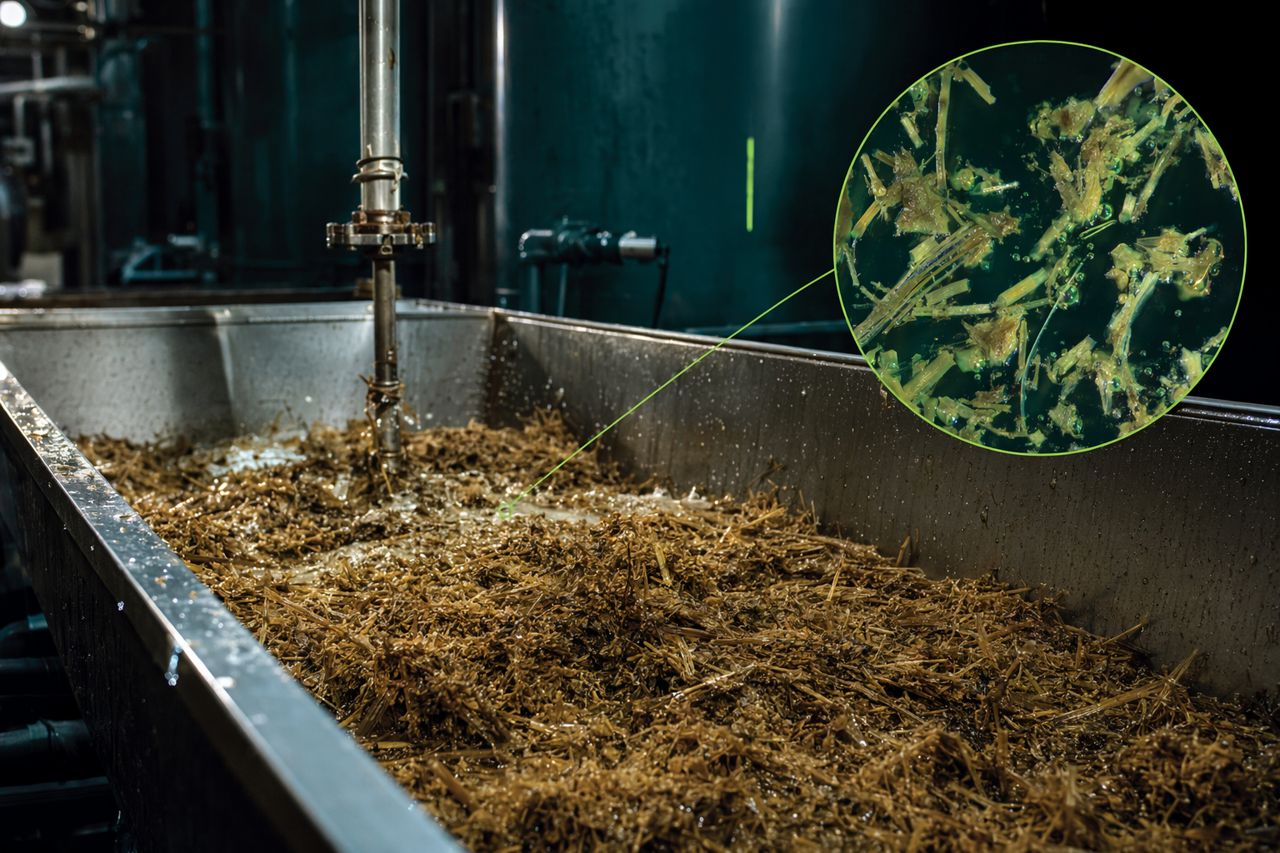
The challenge is not simply that straw is dry or fibrous. The real bottleneck is access. Microbes need reachable carbohydrates. Straw protects those carbohydrates inside a lignocellulosic structure that resists fast breakdown, raises viscosity, slows hydrolysis, and can increase process stress when loading rates are pushed too quickly.
For operators, the result is familiar: floating layers, uneven mixing, higher parasitic energy demand, variable gas response, foam events, and a retention-time penalty that makes the business case harder to defend.
AneroShift works with biogas plants as an enzyme supplier for biogas production, with a practical focus on feedstock variability, digester stability, and measurable trial protocols. Straw pretreatment is one of the clearest places where plant-aware enzyme strategy can support operations when it is designed around the actual substrate, not a generic promise.
Straw is built to stand upright in a field. That same structure makes it resistant in a digester.
Key constraints include:
Pretreatment is used to reduce these constraints before or during digestion. But not every pretreatment method solves the same problem, and not every plant has the equipment, energy margin, or labor bandwidth to manage a complex front-end process.
Farm-scale biogas plants often run close to their operational limits. A small change in feedstock quality can alter viscosity, pumpability, VFA trend, foam tendency, and gas stability.
When straw is introduced or increased, the plant may see:
This is why straw can look economical in procurement but expensive in operation. If the plant cannot unlock the substrate efficiently, the feedstock occupies digester volume without delivering its potential methane contribution on the required timeline.
Many operators start with physical approaches:
These steps can help. Smaller particles increase surface area. Better wetting improves contact. Heat can soften parts of the structure.
But physical disruption does not automatically convert protected fiber into accessible substrate. It may also raise energy use, maintenance demand, and equipment wear. At farm scale, those trade-offs matter.
The question is not whether mechanical pretreatment is good or bad. The question is whether it is enough for the methane target, retention-time target, and plant stability target.
Enzyme-led straw pretreatment is used to support faster access to the fibrous fraction. In practical terms, the goal is to help the plant move from resistant fiber toward more available material without adding unnecessary process stress.
AneroShift approaches this through feedstock-specific enzyme strategies aimed at:
Enzymes are not a substitute for basic plant discipline. Chop length, feeding rhythm, inoculum health, trace nutrient balance, temperature control, and mixing all still matter. But when those fundamentals are under control, enzyme pretreatment can become a targeted lever for unlocking straw value.
Straw is not one uniform material. Wheat straw, barley straw, rye straw, and maize stover can behave differently. Storage conditions, moisture, weather exposure, soil contamination, and chopping quality all influence response.
A generic enzyme recommendation can miss the mark because it does not account for:
This is why AneroShift does not position enzyme supply as a blind additive sale. For biogas operators, the value is in the protocol: define the bottleneck, match the enzyme strategy, protect the digester, and measure the response against baseline operation.
A successful straw pretreatment trial should be simple enough for the plant team to run, but disciplined enough to produce decisions the finance and operations teams can trust.
Before changing enzyme strategy, capture the current operating picture:
The baseline does not need to be complicated. It needs to be consistent.
Do not trial enzymes against a vague goal such as better digestion. Choose a plant-relevant target.
Common targets include:
The cleanest trials avoid multiple simultaneous changes. If the plant changes feedstock, loading rate, trace elements, mixing schedule, and enzyme application at the same time, the result becomes hard to interpret.
AneroShift supports trial design that keeps the comparison practical. The operator should know what changed, when it changed, and which KPIs should move first.
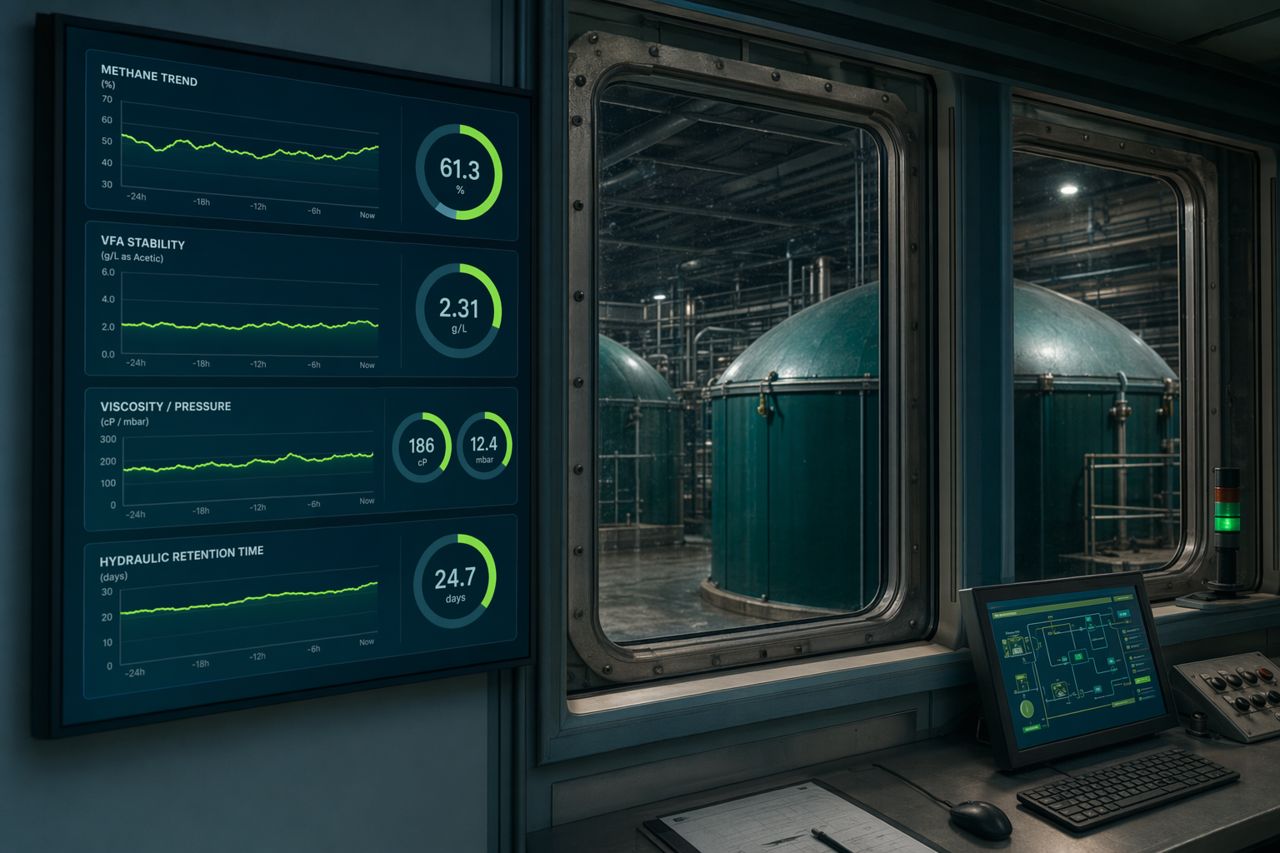
Methane uplift is important, but it may not be the first useful signal. In straw-rich systems, operators may first observe:
These indicators help determine whether hydrolysis access is improving before the final production economics are calculated.
At the end of the trial window, compare against the baseline:
The decision should be based on plant value, not on enzyme cost alone. If the enzyme strategy allows more straw to be used reliably, reduces operating stress, or improves methane response from an existing feedstock, the commercial case may be stronger than a simple additive-cost comparison suggests.
Adding more straw because it is available can push the digester into instability before the hydrolysis bottleneck is addressed. Enzyme strategy should support loading decisions, not excuse aggressive loading.
Total gas can move for many reasons. Methane concentration, VFA behavior, foam events, and operational handling give a clearer picture of whether the plant is actually improving.
Long, dry, poorly wetted straw is harder to manage. Enzyme support works best when the plant also pays attention to chop quality, feeding consistency, and contact time.
Two digesters using similar straw can still respond differently because microbial ecology, co-substrates, retention time, and mixing are different. A plant-specific approach is more reliable.
AneroShift is built for industrial biogas conversations, not consumer-style claims. When we discuss straw pretreatment, we focus on what matters at the plant:
As an enzyme supplier for biogas production, AneroShift supports operators who need a controlled route to test enzyme value under their own conditions.
If straw is limiting your biogas plant through slow hydrolysis, viscosity, floating layers, foam pressure, or inconsistent methane response, AneroShift can help define an enzyme-led trial protocol for your feedstock mix.
Use the on-site request a quote form and include:
Request a quote through the on-site form to discuss a plant-specific straw pretreatment plan.
Tell us your application and volume — we reply with pricing and lead time.
We have received your message. We will reply by email.